
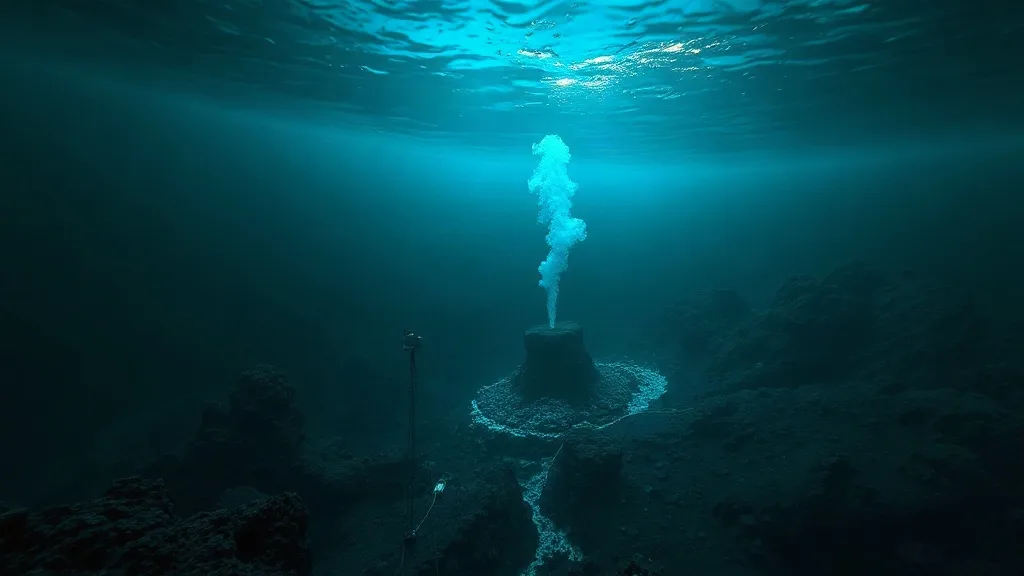
Seven thousand three hundred years ago, a volcano off the southern coast of Japan did something that reshaped the seafloor and scattered ash across a wide stretch of East Asia. Today, the same structure, the Kikai caldera, is showing signs that it is slowly stocking up on magma again. That detail, buried in an underwater seismic survey, is the kind of finding that makes volcanologists sit up and pay attention, not because an eruption is imminent, but because it offers a rare window into how the planet's biggest volcanic systems recharge themselves.
The work behind the discovery relied on seismic imaging conducted beneath the sea surface, a technique that maps how sound waves travel through rock and molten material. What the surveys revealed is a substantial body of magma that appears to have accumulated in the years since the ancient eruption, sitting beneath the caldera floor. In other words, the plumbing system that once fed a catastrophe is not dormant in the way a casual observer might assume. It is, in a geological sense, refilling.
What the Kikai Caldera Actually Is
A caldera is not a mountain in the familiar sense. It is a depression, often a broad sunken basin, formed when a volcano collapses after emptying a huge volume of magma in a single event. Kikai, located in the waters south of Kyushu, fits that description. Its eruption roughly 7,300 years ago is counted among the largest known volcanic events of the recent geological past, and its effects reached well beyond the caldera itself, leaving ash layers that researchers can still trace today.
That history matters because it tells us what kind of system we are dealing with. This is not a small vent that puffs out lava every few decades. It is a large, long-lived magmatic system with the capacity to store enormous quantities of molten rock underground. Understanding what is happening beneath it now requires thinking in terms of thousands of years, not news cycles.
How Scientists Peek Beneath the Seafloor
Studying a caldera that sits underwater is a logistical challenge. You cannot simply walk up to it and take samples. Instead, researchers deploy instruments that listen to seismic waves and interpret the way those waves speed up, slow down, or bend as they pass through different materials. Molten or partially molten rock behaves differently from solid rock, and those differences show up in the data.
From these surveys, scientists can build a picture of where magma is stored, roughly how much of it is present, and how it is distributed. The recent imaging of Kikai points to a large magma reservoir that has been building up since the ancient eruption. This is not a claim that a repeat event is around the corner. It is a claim about process: the system is actively accumulating material.
Why Partial Melt Is the Key Detail
One nuance worth understanding is that a magma reservoir is rarely a single underground lake of liquid rock. More often it is a sponge-like mixture of solid crystals, liquid melt, and dissolved gases. Seismic imaging can detect the presence of melt, but it struggles to tell you exactly how much liquid is there and whether it is connected enough to move. A reservoir that is refilling is not the same as a reservoir that is ready to erupt. That distinction is central to how volcanologists interpret findings like this one.
Why This Matters Beyond Japan
The Kikai finding is interesting on its own, but its real value is comparative. Supervolcanoes are rare, and the ones we know best, such as Yellowstone in the United States and Toba in Indonesia, are studied intensely. Each new system that scientists can image adds a data point to a broader question: how do these enormous volcanic systems recover after a major eruption?
The answer appears to involve long, slow, episodic recharge. Magma rises from deeper sources, accumulates in reservoirs, and sometimes stalls. Over thousands of years, the system can rebuild enough material to support another large event, though the timing is anything but predictable. Kikai gives researchers a chance to watch that recharge process in a system that has already produced a major eruption, which is precisely the scenario that models try to capture.
There is also a practical dimension. Better imaging of magma reservoirs, whether at Kikai, Yellowstone, or elsewhere, improves the groundwork for monitoring. If scientists know where magma is stored and how it is distributed, they can better interpret changes in seismicity, ground deformation, and gas emissions. None of that predicts an eruption on its own, but together these signals form the basis of modern volcanic monitoring.
What This Does and Does Not Mean
It is easy for headlines about supervolcanoes to slide into catastrophe framing. The more useful reading of the Kikai research is calmer. A refilling magma reservoir is a normal part of how large volcanic systems behave over geological time. The finding tells us the system is active and evolving, which is valuable scientific information, but it does not translate into a near-term hazard for the region.
What it does suggest is that the story of a supervolcano does not end with its biggest eruption. The system can persist, recharge, and potentially produce future activity, though the timescales involved are measured in millennia. For anyone who follows volcanology, that is the genuinely interesting part: the planet's largest volcanic systems are not static relics. They are ongoing processes, and we are only now getting the tools to watch them closely.
The Role of Underwater Surveys Going Forward
Much of the world's volcanic activity happens beneath the oceans, which means it is understudied relative to what happens on land. Marine seismic surveys are changing that, slowly. Each successful campaign adds detail to a map that is still largely incomplete. Kikai is one entry on that map, and its value will grow as researchers compare it with other submarine calderas.
Frequently Asked Questions
Is the Kikai supervolcano going to erupt soon?
There is no indication from the reported findings that a near-term eruption is expected. The research describes a magma reservoir that has been refilling over thousands of years, which is a long-term geological process rather than an immediate warning sign. Volcanic hazards are assessed through continuous monitoring of seismic activity, ground movement, and gas emissions, not from a single imaging study.
How do scientists know magma is refilling beneath a caldera?
They use seismic imaging, which measures how sound waves travel through the subsurface. Molten or partially molten rock changes the speed and path of those waves in ways that solid rock does not, allowing researchers to infer where magma is stored and roughly how much is present.
Why is Kikai compared to Yellowstone and Toba?
All three are large caldera systems that have produced enormous eruptions in the geological past. Studying how Kikai recharges its magma supply gives scientists a comparison point for understanding the same processes at other supervolcanoes, where direct observation is equally difficult.
Does a refilling reservoir mean another giant eruption is coming?
Not necessarily. Recharge is a normal part of how these systems behave, and it can continue for a very long time without producing a major eruption. The timing and scale of future activity depend on factors that scientists are still working to understand, including how magma moves, stalls, and interacts with the surrounding crust.
Why is underwater volcanology important?
A large share of Earth's volcanic activity occurs beneath the oceans, yet it receives far less study than land-based volcanoes. Marine surveys help close that gap, and findings like the Kikai imaging show how much can be learned from looking carefully at systems that are hidden below the sea surface.