
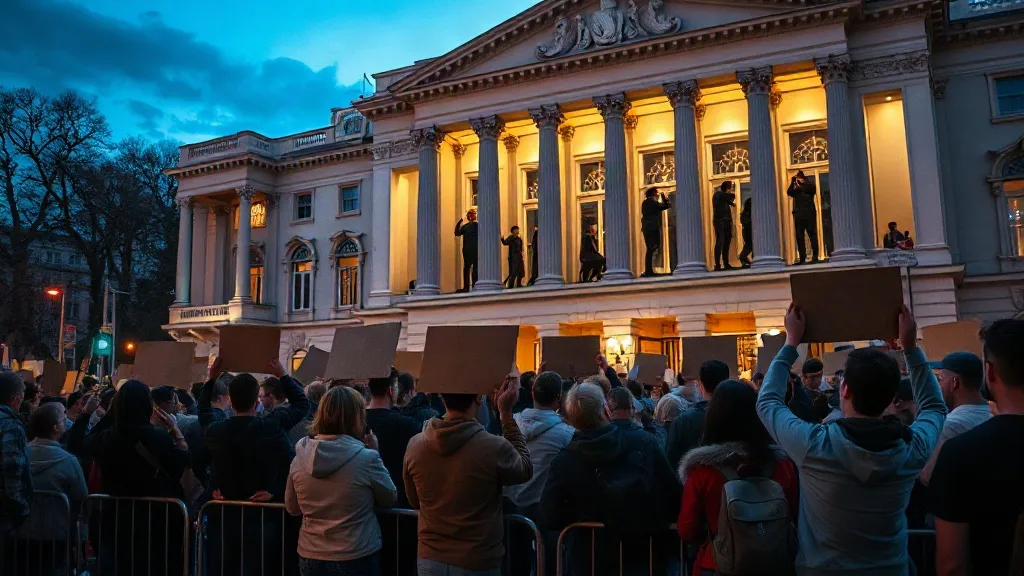
For ten days now, the square outside Albania's parliament in Tirana has belonged to students. On Thursday, the building itself briefly belonged to chaos. Rival MPs traded heated words and physical confrontations on the chamber floor while, just beyond the walls, demonstrators kept up the vigil that has become the defining image of this standoff. Two arenas, one country, and a gap between them that seems to be widening rather than closing.
What happened inside the chamber was not a debate in any ordinary sense. It was the kind of scene that tells you more about a political system's temperature than any communique could. Lawmakers who are supposed to hash out differences through procedure instead found themselves in heated exchanges that turned the session into a spectacle. The timing could hardly be more charged: the disruption came on the same day the student protest movement reached its tenth consecutive day, a milestone that in Albanian politics carries its own weight.
Why the Tenth Day Matters
Protest movements rarely survive their first week. The ones that do tend to cross a psychological threshold, both for the people in the streets and for the government watching them. Ten days of sustained turnout suggests organization, stamina, and a core of participants who are not simply venting but are committed to a longer campaign. That is a different kind of pressure than a single angry afternoon.
Students have historically occupied a special place in Albanian public life. University campuses have been the launching pad for some of the country's most consequential civic movements, and the sight of students camping out in the capital's center resonates in a way that a generic political rally often does not. It reads as youthful, untainted by party machinery, and hard for the authorities to dismiss without seeming heavy-handed.
The parallel timing on Thursday is what turned a familiar protest story into a genuine political flashpoint. When the streets and the chamber are both boiling at the same moment, the question stops being whether the government will respond and becomes how, and how fast.
What the Clashes Signal About Albania's Institutions
Parliamentary confrontations are not new to Albanian politics. The country's legislature has a reputation for volatility, and observers who follow the region have seen sessions devolve before. But the context matters enormously here. A chamber that erupts while citizens are camped outside its doors is a chamber whose legitimacy is being questioned in real time, and the optics cut against the institution.
There is a subtler concern as well. When political confrontation replaces deliberation, the practical business of governing stalls. Legislation gets postponed, oversight mechanisms go quiet, and the public's sense that parliament exists to solve problems erodes further. For a country that has spent years working to strengthen its democratic institutions, scenes like Thursday's are a setback that opponents and skeptics will remember.
The student demonstrators, for their part, appear to have calculated that the institutional channel is not delivering. Their persistence outside the building is, in effect, a running commentary on what is happening inside it. Each day the protests continue, the contrast sharpens: orderly, disciplined students on one side, disorder in the chamber on the other.
The Background Nobody Should Skip
To understand why this moment feels combustible, it helps to step back from the immediate images. Albania has a long history of mass protest as a tool of political change, and it has also developed a pattern in which demonstrations and institutional crises feed each other. When public frustration builds and formal channels seem unresponsive, the streets become the venue of last resort.
That said, it is important to be precise about what is known. The source material for this story is narrow: clashes among MPs in parliament and a student protest now in its tenth day. Beyond that, the specific grievances driving the demonstrations, the demands being made, and the government's stated position have not been detailed in what is available. Readers should treat sweeping claims about the cause of the unrest with caution until the picture fills in.
What can be said with confidence is that the two events are now locked in the same news cycle, and that is rarely a coincidence in politics. Protests create pressure that institutions feel, and institutional dysfunction validates the protesters' argument that the system is not working. The feedback loop is the story.
How a Parliament Loses the Room
There is a practical lesson in Thursday's scenes that applies well beyond Albania. Parliaments draw their authority from the perception that they are places where disagreement is managed, not merely expressed. Once that perception frays, the building's symbolic power weakens, and the street becomes the more credible stage. Politicians who treat the chamber as an arena for performance rather than negotiation do their institutions real damage, even when the performance plays well to their own supporters.
What Comes Next
Expect the coming days to be decisive. Three scenarios are worth watching:
- De-escalation through engagement. The government or parliamentary leadership opens a channel to the students, offering talks or concessions. This would lower the temperature and shift the story from confrontation to negotiation.
- Escalation on both fronts. Parliamentary disruptions continue while protests grow or harden, producing a cycle in which each side points to the other as proof of bad faith.
- Fatigue and drift. The movement loses momentum, the chamber returns to routine, and the underlying grievances go unaddressed until the next flashpoint. This is the most common outcome, and often the most corrosive.
Each path carries consequences for Albania's international standing as well. The country has invested heavily in presenting itself as a stable, reform-minded partner in the Balkans, and images of chaos in the chamber travel fast. Diplomats in Tirana will be watching closely, not because they have a stake in any particular faction, but because institutional stability is the currency of the relationship.
The Human Dimension Behind the Headlines
It is easy to reduce a story like this to a scoreboard of wins and losses. But the tenth day of a student protest means ten nights of sleeping away from home, ten days of missed classes, and a level of conviction that deserves more than a passing mention. Likewise, a parliament that cannot conduct its business is a parliament that is failing the people who sent its members there, whatever their party.
The most useful thing outside observers can do is resist the temptation to flatten the story into a simple morality tale. Student protests and parliamentary clashes are symptoms of a deeper negotiation over who gets heard and how. That negotiation is happening in Tirana right now, in two rooms at once, and its outcome will shape Albanian politics long after the cameras leave.
Frequently Asked Questions
What exactly happened in Albania's parliament?
Rival members of parliament engaged in heated exchanges and chaotic confrontations during a session in Tirana. The disruption coincided with the tenth consecutive day of student demonstrations outside the building.
Why are students protesting in Albania?
The available reporting confirms that student demonstrators have been rallying outside parliament for ten days but does not detail the specific demands behind the movement. Readers should look for follow-up coverage that clarifies the protesters' stated goals.
Is the protest connected to the parliamentary clashes?
The two events occurred on the same day and in the same location, and they are being reported together. Whether the parliamentary confrontation was directly triggered by the protests has not been confirmed in the available information.
How long is the protest expected to continue?
There is no confirmed end date. Passing the ten-day mark suggests the organizers intend to sustain the movement, but its duration will depend on how the government responds and whether a dialogue opens.
Why does this matter outside Albania?
Albania's institutional stability affects its regional role and its relationships with international partners. Disorder in parliament and sustained street protests are signals that observers and diplomats will read closely.