
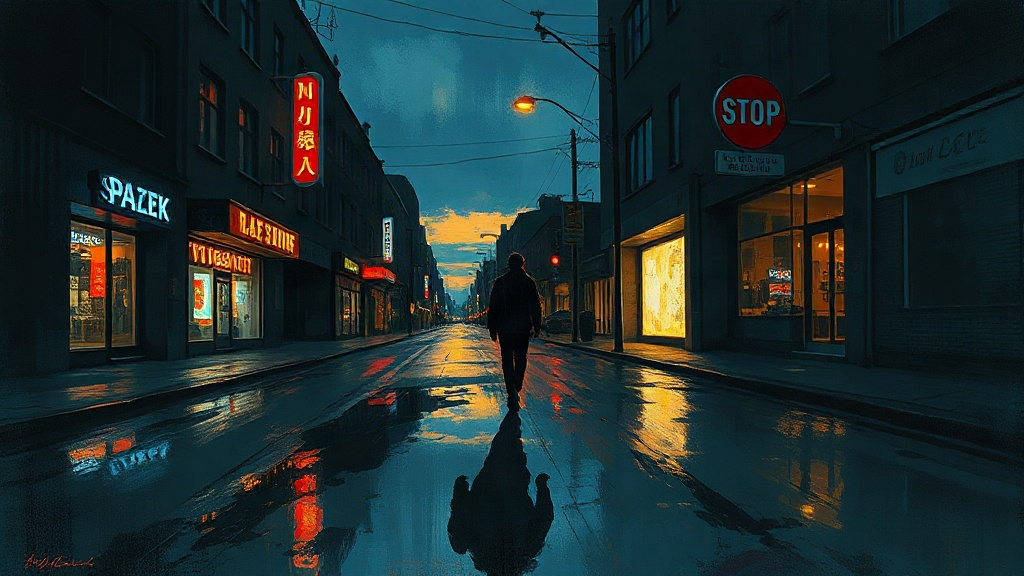
In the contemporary art world, recognition often arrives gradually, but for Florian Krewer, it has come in bold, unmistakable strokes. The German-born, New York-based painter has secured a solo exhibition at the Musée d'Art Moderne de Paris, one of France's most prestigious institutions for modern and contemporary art. This show not only cements Krewer's status as a rising star but also invites viewers into his enigmatic world, where the boundaries between reality and fantasy blur. Krewer's work is a study in contrasts: light and shadow, intimacy and alienation, the familiar and the uncanny. His paintings capture moments that feel both fleeting and eternal, drawing on personal experience while resonating on a universal level.
For those unfamiliar with Krewer's oeuvre, his canvases often depict figures in ambiguous settings—city streets at dusk, dimly lit interiors, or lush, dreamlike landscapes. These scenes are not mere backdrops; they are active participants in the narrative, shaping the emotional tenor of each piece. The Paris exhibition promises to be a comprehensive survey of his recent work, offering a deep dive into his evolving practice. But what exactly makes Krewer's art so compelling, and why does it merit such a significant platform? The answer lies in his ability to navigate the spaces between—the liminal zones where identity is fluid and meaning is constantly negotiated.
A Transatlantic Journey: From Germany to New York
Florian Krewer was born in Germany, but his artistic identity is deeply intertwined with New York City, where he has lived and worked for years. This transatlantic background infuses his work with a unique perspective, blending European sensibilities with the raw energy of the American metropolis. Krewer's paintings often reflect the solitude and anonymity of urban life, yet they also celebrate moments of connection and tenderness. His figures, frequently young men, are depicted in states of vulnerability—sleeping, embracing, or simply gazing into the distance. These intimate portrayals challenge traditional notions of masculinity and invite viewers to reconsider the boundaries between public and private selves.
New York itself plays a crucial role in Krewer's visual language. The city's neon-lit nights, its crowded subways, and its hidden corners all find their way onto his canvases. But Krewer is not a documentary realist; he transforms these observations into something more poetic. A streetlamp becomes a halo, a park bench a stage for quiet drama. By doing so, he encourages us to see the extraordinary within the ordinary—a skill that has earned him comparisons to painters like Peter Doig and Michaël Borremans, though his voice remains distinctly his own.
The Spaces Between: Themes and Motifs
At the heart of Krewer's practice is an exploration of liminality—the quality of being in-between. This manifests in various ways: the transitional hours of dawn and dusk, the blurred lines between dream and waking life, and the porous boundaries between self and other. His paintings often feature figures who seem to be emerging from or dissolving into their surroundings, as if caught mid-transformation. This sense of flux is both unsettling and beautiful, reflecting the complexities of contemporary existence.
Night and Day
Krewer frequently paints scenes set at night or during twilight, when the world is cloaked in ambiguity. These are not the vibrant nights of nightlife and celebration, but rather the quieter, more introspective hours when solitude reigns. In Untitled (Night Walk), for example, a lone figure strides through a deserted street, his shadow stretching long behind him. The painting captures the eerie calm of a city after dark, when familiar landmarks take on new, mysterious qualities. By focusing on these in-between times, Krewer taps into a collective unconscious—the universal experience of being alone with one's thoughts as the world sleeps.
Body and Environment
Another recurring motif is the relationship between the body and its environment. Krewer's figures are not isolated from their surroundings; they are intimately connected to them, often merging with landscapes or architectural elements. In some works, limbs morph into tree branches or city walls, suggesting a deep interdependence between human and non-human worlds. This ecological dimension adds layers of meaning to his art, prompting us to consider our place within the natural and built environments. It also reflects Krewer's interest in phenomenology—the study of subjective experience—and how our perceptions shape reality.
Memory and Imagination
Krewer's paintings often feel like memories or dreams, hovering between the specific and the vague. He draws on personal experiences but deliberately leaves details unclear, allowing viewers to project their own narratives onto the scenes. This interplay between memory and imagination is central to his work. In The Visit, a group of figures gathers in a sunlit room, their faces obscured or turned away. The painting evokes a sense of nostalgia and loss, yet it remains open to interpretation. Is it a family reunion, a farewell, or something else entirely? By refusing to provide easy answers, Krewer invites us to become active participants in the meaning-making process.
Why This Exhibition Matters
A solo show at the Musée d'Art Moderne de Paris is a significant milestone for any artist, but for Krewer, it represents something more: a validation of his unique approach to painting. In an art world often dominated by conceptualism and digital media, Krewer's commitment to the tactile, expressive potential of oil on canvas is noteworthy. His work demonstrates that painting can still be a vital, relevant medium for exploring the complexities of contemporary life. Moreover, the exhibition provides an opportunity for European audiences to engage with his art in depth, fostering a dialogue between American and European artistic traditions.
The timing of the show also feels apt. As the world grapples with issues of identity, migration, and belonging, Krewer's exploration of in-between spaces resonates deeply. His figures are often outsiders or wanderers, navigating unfamiliar territories. They embody the experience of displacement, but also the resilience and creativity that can emerge from it. In this sense, Krewer's art is not just personal; it is political, offering a nuanced perspective on some of the most pressing questions of our time.
What to Expect at the Musée d'Art Moderne
While the exact layout of the exhibition has not been publicly detailed, visitors can anticipate a carefully curated selection of Krewer's recent paintings, possibly alongside some earlier works that trace the development of his style. The museum's spacious galleries will allow his large-scale canvases to breathe, creating an immersive environment that enhances the atmospheric quality of his art. Expect to see recurring motifs—the lone wanderer, the intimate encounter, the twilight cityscape—arranged in a way that highlights their interconnectedness. The show may also include new works created specifically for the Paris context, offering a fresh perspective on his practice.
For those planning to attend, it's worth taking time to sit with each painting. Krewer's work rewards slow looking; details that seem insignificant at first glance—a stray gesture, a particular shade of blue—often hold the key to understanding the whole. The exhibition is likely to be a contemplative experience, one that invites introspection and emotional engagement rather than quick consumption.
The Artist's Background and Rise
Florian Krewer's journey to international recognition has been marked by steady, deliberate steps. After studying at the Kunstakademie Düsseldorf, he moved to New York, where he quickly became part of a dynamic community of artists. His early work caught the attention of critics and collectors alike, leading to exhibitions at prominent galleries such as Michael Werner and Tramps. Over the years, his style has evolved, becoming more confident and expansive, yet always retaining a core of emotional honesty. This authenticity is perhaps the quality that sets him apart in a crowded field.
Krewer's rise also reflects broader shifts in the art market, where figurative painting has experienced a resurgence. But unlike some of his peers, Krewer avoids nostalgia or pastiche; his work feels urgently contemporary, grappling with the anxieties and aspirations of the present moment. This is why his Paris show is not just another exhibition but a statement: that painting can still surprise, move, and provoke.
Frequently Asked Questions
When and where is Florian Krewer's solo exhibition taking place?
The exhibition is scheduled at the Musée d'Art Moderne de Paris. For exact dates and opening hours, it is best to check the museum's official website or contact them directly, as schedules can change.
What themes does Krewer explore in his paintings?
Krewer's work often explores liminal spaces—the transitional moments and ambiguous territories between night and day, body and environment, memory and imagination. His paintings frequently feature figures in urban or natural settings, capturing a sense of solitude, intimacy, and transformation.
Is the exhibition suitable for children?
While Krewer's paintings are not explicitly violent or explicit, they do contain mature themes and complex imagery that may be better appreciated by older audiences. Parents should use their discretion, and the museum may provide guidance on age suitability.
How can I learn more about Florian Krewer's art?
Beyond visiting the exhibition, you can explore Krewer's work through art publications, online galleries, and catalogues from his previous shows. Many of his paintings are also available for viewing on the websites of galleries that represent him.
Will there be guided tours or educational programs?
Museums like the Musée d'Art Moderne often offer guided tours, talks, and workshops for special exhibitions. Check their event calendar for details once the exhibition opens. These programs can provide valuable context and enhance your understanding of Krewer's work.