
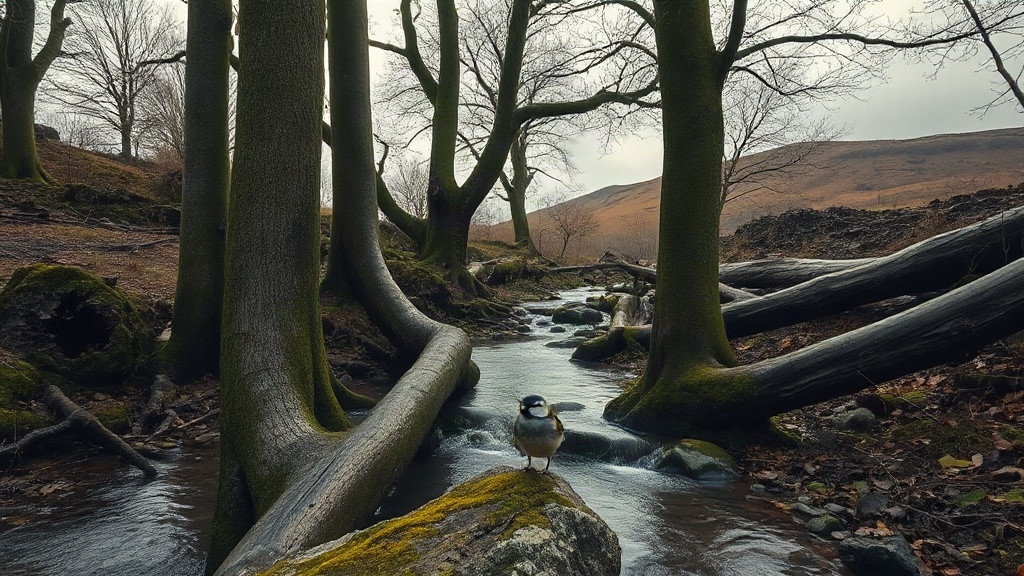
The grey wagtail does not care about the storm. It dips along the stream's edge, its pale yellow underside blending into the tawny palette of autumn, hunting the midges and water snails that have returned since the water began to flow properly again. A few months ago that hunt would have been futile. The streambed had shrunk to a chain of stagnant pools, and the birds moved on. Sitting here now, with the water chattering over stones and the woodland wearing its russet colours, it is tempting to read the scene as recovery. The land, however, keeps a longer memory than we do.
At the entrance to these woods, the evidence is still raw. Scots pines and ageing oaks lie torn from the ground at ugly angles, roots exposed like unfinished excavations. This is the residue of Storm Goretti, the system that battered the UK earlier this year with snow and destructive winds, and many months on, nobody has cleared the debris. Just over a mile away, a gorse break along the coastline remains blackened from a late-summer wildfire. The western gorse should be flowering by now, releasing the faint coconut scent that draws late pollinators out in the cooling weeks of the year. Instead, the shrubs stand as petrified stumps, jutting seaward without a trace of life.
Two disasters, different in kind, arriving within a single calendar year. That pairing is what makes this corner of Cornwall worth paying attention to. It is not simply that the weather was bad. It is that the landscape was asked to absorb a storm and a fire in quick succession, and the question now is whether it can absorb a winter on top of that.
Why a Storm and a Fire Tell the Same Story
Storms and wildfires are usually discussed as separate hazards, handled by separate agencies with separate budgets. On the ground, they are two expressions of the same underlying pressure: a climate that swings harder between extremes, with wetter, windier winters and hotter, drier summers. The mechanisms are well understood. Warmer air holds more moisture, so when rain comes it tends to arrive in heavier bursts. Warmer summers pull that moisture back out of soils and vegetation, leaving fuels dry and receptive to ignition.
What is less often appreciated is how one event sets up the next. A storm that tears a canopy open lets sunlight reach the forest floor, drying leaf litter and undergrowth that would otherwise stay damp. Fallen timber becomes fuel. Root plates ripped from the soil create hollows that hold water in winter and bake hard in summer. A landscape that has just been through a wind event is, in a real sense, a landscape primed for fire.
That sequence is visible here. The fallen pines at the wood's entrance are now in their second season on the ground, their needles long gone, their trunks silvering. The gorse that burned was growing on thin coastal soils that drain fast and dry quickly. Neither event was inevitable on its own. Together, they suggest a pattern rather than a run of bad luck.
What the Damage Actually Costs
It is easy to look at a fallen oak and see only a fallen oak. The real losses are slower and more layered.
- Soil. When roots are wrenched out, topsoil goes with them. On slopes, the next heavy rain washes that soil into streams, silting spawning gravels that fish depend on.
- Water. A stream that nearly dried in summer and then floods in winter is a stream with no buffer. Vegetation that would normally slow runoff has been removed, so rainfall reaches the channel faster.
- Pollinators. Burned gorse means no late-season nectar in that patch. Insects that timed their life cycles to those flowers must travel further or fail.
- Carbon. Standing trees store carbon. Burning shrubs release it. A wood that loses canopy and undergrowth in the same year is temporarily working against itself.
None of these effects is catastrophic in isolation. Cumulatively, they erode the margin of safety that lets an ecosystem absorb the next shock. That margin is the whole point. Resilience is not about preventing every storm or every spark. It is about how much a system can take before it flips into a different, poorer state.
Reading the Signs Before Winter Arrives
There are practical ways to judge how much margin is left, and they do not require laboratory equipment. Look at the ground. Bare soil on a slope after a storm is a warning. Look at the water. A stream that runs turbid after the first autumn rain is carrying away the soil that took centuries to build. Look at what is flowering. If the gorse, heather and ivy that should feed late insects are absent or dead, the food web is thinner than it looks.
Then look at what is still standing. Mature trees with intact root systems, hedgerows left uncut through the winter, rough grass margins along field edges: these are the structures that slow water, hold soil and shelter insects. Their value is rarely counted because nothing was spent to create them. That is precisely why they are the first things lost when land is tidied too aggressively.
What a Hard Winter Would Mean
The specific concern for the coming months is compound stress. A waterlogged soil cannot absorb more rain. A tree whose roots were loosened by one storm is more likely to fall in the next. A gorse stand that burned before it could set seed has no bank of dormant seeds waiting to regenerate. If winter brings repeated gales and heavy rain, the damage does not simply add up. It multiplies.
There is also the question of what happens after. Fires need three things: fuel, oxygen and an ignition source. Winter rain suppresses ignition, but it also drives growth. A wet winter followed by a warm, dry summer produces more vegetation than a dry winter does. In fire-prone landscapes, the wet year is often the setup for the bad fire year. That is why the damage from this year matters beyond this year.
Building Back With More Give
Resilience is not a single intervention. It is a set of choices that give a landscape more slack.
- Leave fallen wood where it is safe to do so. Deadwood holds moisture, shelters invertebrates and slowly returns nutrients to the soil.
- Keep hedgerows and field margins tall and thick. They act as windbreaks, slow runoff and provide continuous habitat.
- Plant a mix of species, not a single crop. Diversity means no single pest, drought or disease can take everything at once.
- Protect stream banks with native vegetation. Roots hold soil and shade the water, keeping it cooler and more oxygenated.
- Plan fire breaks and access routes before the season, not during it. Gorse management, in particular, benefits from age diversity, so that a single fire cannot remove every stand at once.
These measures do not require grand schemes. Most of them cost little more than restraint and forethought, and many work best when applied at the scale of a single field or wood.
Frequently Asked Questions
Why did the stream nearly dry up and then flood in the same year?
Both extremes come from the same change. Warmer air holds more water vapour, so rainfall arrives in heavier, less frequent bursts. Between those bursts, soils and vegetation dry out faster. The result is a stream that runs low for months and then rises sharply when the rain finally comes.
Can a burned gorse stand recover on its own?
Often yes, but slowly. Gorse can resprout from surviving rootstock and from seeds stored in the soil, though seeds need heat to germinate and the stand may take several years to return to full flower. Where the fire burned hot and deep, recovery can be patchy.
Does leaving fallen trees in place increase fire risk?
It can, which is why the decision is site-specific. In damp woodland, deadwood is a net benefit. In dry, fire-prone areas, large accumulations of dead fuel near settlements or access routes may need to be reduced. The goal is a balance, not a blanket rule.
What is the single most useful thing to watch this winter?
Water. Where it goes, how fast it moves and how muddy it looks tells you almost everything about the health of the land above it. Clear, slow water means the soil is holding. Fast, brown water means it is leaving.
Is this level of damage unusual for Cornwall?
Individual storms and fires are not new to the region. What stands out is the compression of events into a single year, with a severe storm followed by a coastal wildfire. That clustering is the signal worth watching, because it tests the landscape's capacity to recover between shocks.
The wagtail has moved on downstream, following the water. Whatever winter brings, the land here will carry the record of this year into the next, in fallen trunks, in silted gravels, in the absence of a scent that should have been in the air by now. How much more it can carry is the open question, and it will be answered not by the weather alone but by what we choose to leave in place.